 sales@isummation.com
 +1 302 202 3260
- December 22, 2025
- Posted by: iSummation Team
- Category: Mobile Development

Choosing the right mobile development approach is a critical decision that impacts your budget, timeline, and user experience. Whether you’re launching a new start-ups or scaling an existing product, understanding the core differences between native and cross-platform app development is essential. This guide will help you navigate the debate of cross-platform vs. native, breaking down the pros and cons of each to help you make an informed choice for your project.
What is Native App Development?
Native app development involves creating software built specifically for a single mobile operating system. This means you use platform-specific programming languages and tools. For iOS, developers use Swift or Objective-C, while Android development relies on Kotlin or Java.
A native app dev approach ensures that the application is fully optimized for the device’s hardware and OS. Because the app is built in the device’s native language, it can directly access features like the camera, GPS, and microphone, delivering high performance and a seamless user experience. This direct integration is a key differentiator in the native vs. cross-platform mobile development comparison.
What is Cross-Platform App Development?
Cross-platform app development allows developers to write a single codebase that runs on multiple operating systems, including iOS and Android. This “write once, run anywhere” model streamlines the mobile phone application development process significantly. Instead of building two separate apps, a development team can use a single cross-platform mobile development tool to create an app that functions on both platforms.
Popular frameworks for cross-app development include:
- React Native: Developed by Facebook, it allows developers to build mobile apps using JavaScript and React.
- Flutter: Created by Google, this UI toolkit enables the creation of natively compiled applications from a single codebase.
- Xamarin: A Microsoft-owned framework that uses C# to build apps for multiple platforms.
This approach has become a popular choice for businesses looking to reach a wider audience quickly and efficiently.
Advantages of Native Application Development
Opting for a native app development platform offers several distinct benefits that make it the preferred choice for performance-intensive applications.
Superior Performance and Speed
Native apps are known for their speed and reliability. They are compiled in the platform’s native code, allowing them to run faster and more smoothly. This direct communication with the device hardware minimizes performance lags, resulting in quicker load times and more responsive interactions, which is a major factor in the mobile development native vs. cross-platform debate.
Enhanced User Experience (UX)
Native apps adhere to the specific UI/UX guidelines of their respective operating systems (Apple’s Human Interface Guidelines for iOS and Google’s Material Design for Android). This creates an intuitive and familiar experience for users, as the app’s look, feel, and navigation align with other native apps on their device. The result is higher user engagement and satisfaction.
Full Access to Device Features
A key advantage of native app development is unrestricted access to all device hardware and software features. From the latest camera APIs and push notifications to GPS and Bluetooth sensors, native apps can leverage the full power of the device without relying on third-party plugins or workarounds.
Disadvantages of Native App Development
While powerful, the native approach has its drawbacks, primarily concerning time and resources.
Higher Development Costs
Building two separate apps requires two distinct development teams, one for Android and one for iOS development. If you decide to hire developers for each platform, the costs for salaries, training, and tools can add up quickly, making this a more expensive option. application development company will often charge more for building two native apps compared to one cross-platform solution.
Longer Time-to-Market
Managing two separate codebases and development cycles naturally takes more time. The process of building, testing, and deploying two individual apps means a longer timeline to get your product in front of users.
Complex Maintenance
Post-launch, every update, bug fix, or new feature must be developed and rolled out separately for both the iOS and Android versions. This doubles the maintenance effort and increases the complexity of keeping both apps synchronized.
Advantages of Cross-Platform App Development
Cross-platform mobile development has gained significant traction by offering a more efficient alternative to the native approach.
Code Reusability and Efficiency
The core benefit of cross-platform app dev is code reusability. Developers can write the code once and use it on both iOS and Android platform. This sharing of up to 90% of the codebase drastically reduces development effort and streamlines the entire process.
Faster Time-to-Market
With a single codebase and a unified development team, you can build and launch your app on both platforms simultaneously. This accelerated timeline is a huge advantage for businesses aiming to capture market share quickly.
Reduced Development Costs
A single codebase means you need a smaller development team, fewer resources, and a more consolidated tech stack. This efficiency translates directly into lower development and maintenance costs, making cross-platform development a budget-friendly option.
Disadvantages of Cross-Platform App Development
Despite its benefits, the mobile app development cross-platform approach comes with certain trade-offs.
Potential Performance Limitations
Because cross-platform apps have an additional abstraction layer between the code and the OS, they may not match the raw performance of native apps. For applications that require heavy graphics processing, complex animations, or intensive computations, users might experience slight delays or choppiness.
Slower Access to New OS Features
When Apple or Google releases new features for their operating systems, native app developers can integrate them immediately. Cross-platform frameworks often require an update before these new features become accessible, which can lead to a delay.
UX Inconsistencies
While frameworks like Flutter and React Native have made great strides in mimicking native UI components, achieving a perfectly polished and platform-specific feel can be challenging. Subtle differences in navigation, button styles, and user interactions can sometimes make the app feel slightly “off” to discerning users.
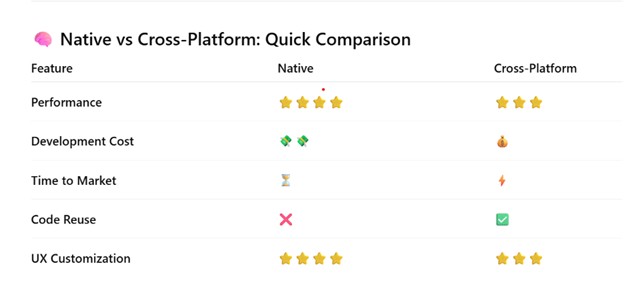
Cross-Platform vs. Native Mobile Development: How to Choose
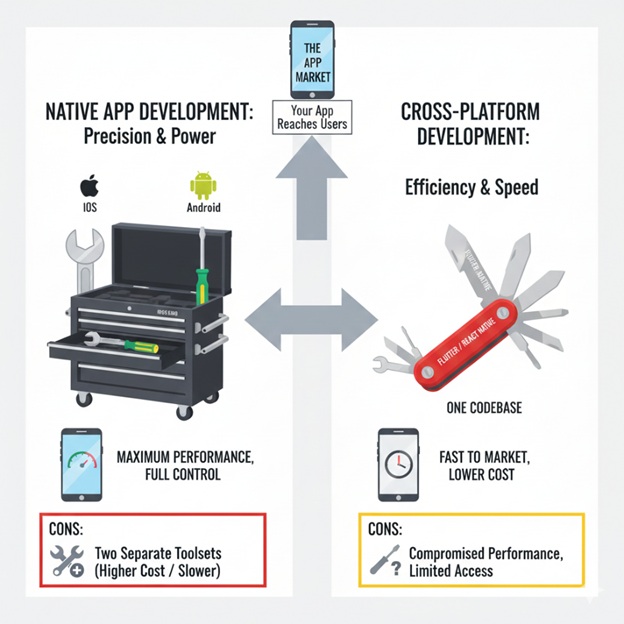
The decision between native and cross-platform development ultimately depends on your business goals, project requirements, and available resources.
Choose Native App Development if:
- Performance is your top priority: Your app is a high-performance game, an AR/VR application, or involves complex animations.
- A flawless UX is non-negotiable: You want your app to feel perfectly at home on each platform, adhering strictly to OS guidelines.
- You need immediate access to the latest device features: Your app relies heavily on advanced hardware capabilities like complex camera functions or device sensors.
Choose Cross-Platform App Development if:
- You have a limited budget and a tight deadline: Your goal is to launch an MVP on both iOS and Android as quickly and cost-effectively as possible.
- Your app is for a broad audience: You need to reach users on both platforms from day one without doubling your development efforts.
- The application is relatively simple: Your app is content-driven or functions as a straightforward business tool without requiring intensive graphics or hardware integrations.
Conclusion
The cross-platform vs. native debate doesn’t have a single right answer. Both native and cross-platform app development offer valid paths to creating a successful mobile application. The best choice is the one that aligns with your strategic goals.
For businesses that prioritize speed, efficiency, and broad market reach, cross-platform app development by a skilled team like Garage 2 Global offers a compelling solution. It allows you to build a high-quality product for both iOS and Android from a single codebase, saving you time and money. If you need top-tier performance and a perfect native user experience, native development remains the gold standard. Carefully weigh your project’s needs to make the best decision for your mobile strategy.

Let’s connect for an enterprise digital solutions to hire developers for software, web and mobile app development.