How AI Workflow Automation is Transforming Enterprise Operations?
AI workflow automation delivers the most value across enterprise functions
- July 23, 2026
- Posted by: iSummation Team
- Category: Strategic IT
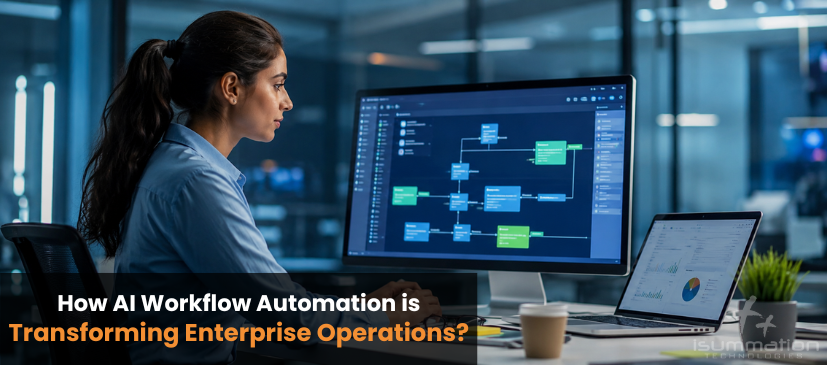
AI workflow automation uses intelligent agents and machine learning to replace manual, rule-based business processes with adaptive, self-learning systems. Enterprises adopting AI-powered workflows report significant gains in efficiency, accuracy, and operational speed – making AI workflow automation one of the most impactful investments available to large organizations in 2026.
The gap between high-performing enterprises and struggling ones is widening – and workflow automation is a key reason why. Companies that once relied on rigid, rule-based software to manage operations are now deploying intelligent workflow automation systems that think, adapt, and act on their own. The shift isn’t subtle. It’s structural.
AI workflow automation refers to the use of artificial intelligence – including machine learning, natural language processing, and autonomous AI agents – to design, execute, monitor, and optimize business processes without constant human intervention. Unlike traditional automation tools that follow fixed scripts, AI-powered workflows respond dynamically to changing data, exceptions, and priorities.
For enterprise leaders, this matters enormously. Business operations at scale involve thousands of interdependent processes: procurement approvals, customer onboarding, data reconciliation, compliance checks, employee requests, and more. Managing these manually – or even with legacy system automation – creates bottlenecks, errors, and rising labour costs. AI workflow management offers a fundamentally different model: one where processes improve themselves over time.
Why AI Workflow Automation Is Smarter Than Traditional Automation?
Traditional workflow automation – think robotic process automation (RPA) or rule-based task managers – executes predefined sequences. If condition A is met, perform action B. These systems are fast and consistent, but brittle. The moment a process changes, an exception appears, or data arrives in an unexpected format, the workflow breaks.
AI workflow automation introduces adaptability. AI-powered agents for business automation in 2026 can interpret unstructured data, make probabilistic decisions, and adjust their behaviour based on feedback loops. A customer service workflow powered by AI, for example, doesn’t just route tickets by keyword – it understands sentiment, urgency, and context, then assigns, escalates, or resolves without a human in the loop.
According to McKinsey’s 2023 State of AI report, roughly 70% of companies have adopted at least one AI function – but fewer than 20% have deployed AI at full operational scale. The opportunity gap is massive, and intelligent workflow automation is where most of that untapped value lives.
The distinction also plays out at the infrastructure level. Enterprise AI solutions built for workflow management integrate with existing ERP, CRM, and ITSM platforms, pulling data in real time and triggering actions across systems – rather than requiring a complete technology overhaul.
Where AI-Powered Workflows Are Delivering the Most Value in Enterprises?
How Is AI Transforming Finance and Procurement Workflows?
Finance operations generate enormous volumes of repetitive, high-stakes tasks: invoice processing, purchase order matching, expense approvals, and audit trail generation. AI workflow automation handles these at scale with near-zero error rates.
AI-powered business automation in procurement, for instance, can analyse supplier contracts, flag anomalies, compare pricing against market benchmarks, and route approvals to the right decision-makers – all within seconds. Traditionally, this process took days. According to Gartner, AI-driven finance automation can reduce invoice processing costs by up to 80% while accelerating cycle times by 60%.
What Role Does AI Workflow Automation Play in IT Operations?
IT service management is another high-leverage area for enterprise workflow automation. AI-powered workflows can detect infrastructure anomalies, auto-generate incident tickets, correlate root causes across distributed systems, and trigger remediation scripts – without waiting for an on-call engineer to respond.
Platforms like ServiceNow and IBM’s watsonx Orchestrate are integrating intelligent workflow automation directly into ITSM pipelines, enabling enterprises to move from reactive to predictive operations. Mean time to resolution (MTTR) drops sharply when AI handles the first 80% of incident classification and response.
How Are AI Agents Being Used for HR and Employee Experience Automation?
Human resources is increasingly a proving ground for AI agents for business task automation in 2026. From onboarding new hires – collecting documents, provisioning accounts, scheduling orientation – to handling employee queries about benefits, leave balances, and policies, AI workflow management tools are replacing a significant portion of transactional HR work.
The result isn’t just efficiency. Employee experience improves when requests are resolved in minutes rather than days. HR teams, freed from repetitive tasks, shift their focus to talent development, culture initiatives, and strategic workforce planning.
How Does AI Workflow Automation Impact Supply Chain and Operations?
Supply chain management demands real-time responsiveness. AI-powered workflows integrate with supplier data, logistics APIs, inventory systems, and demand forecasting models to trigger procurement orders, reroute shipments, and adjust production schedules dynamically.
During supply disruptions – like those experienced during the COVID-19 pandemic – enterprises with AI workflow automation recovered faster because their systems detected signals early and adapted procurement strategies without waiting for human analysis.
Key Capabilities That Define Leading AI Workflow Management Platforms
Not all AI automation software delivers the same results. The platforms generating real enterprise value in 2026 share several distinguishing capabilities.
Autonomous AI agents sit at the centre of advanced enterprise AI solutions. These agents don’t just process tasks – they plan multi-step workflows, use tools like web search or database queries, coordinate with other agents, and escalate to humans only when genuinely needed. Platforms like Microsoft Copilot Studio, Salesforce Agent force, and UiPath’s Autopilot embed these capabilities directly into enterprise environments.
Natural language interfaces allow non-technical users to create and modify workflows without writing code. A business analyst can describe a process in plain English, and the AI workflow automation platform translates that into executable logic – dramatically lowering the barrier to enterprise-wide adoption.
End-to-end process visibility is another critical differentiator. The best AI workflow management platforms provide dashboards that surface bottlenecks, error rates, SLA compliance, and optimization recommendations in real time. This transforms AI process automation from a black box into a transparent operational layer.
Seamless integration with existing enterprise stacks – SAP, Salesforce, Workday, Microsoft 365, ServiceNow – determines whether an AI workflow automation deployment enhances or disrupts current operations. Platforms that require extensive middleware or data migration create adoption friction and delay ROI.
What Are the Biggest Barriers to Enterprise AI Automation Adoption??
Awareness of AI workflow automation has never been higher, yet deployment at scale remains uneven. Several persistent barriers slow adoption even among organizations with the appetite and budget to invest.
Legacy system integration is consistently cited as the top challenge. Many enterprises run core operations on systems that were not designed to interoperate with modern AI platforms. Connecting AI-powered agents to these environments requires middleware, custom APIs, or phased migration – all of which add time and complexity to deployment timelines.
Governance and accountability present a different kind of challenge. When an AI agent makes a consequential decision- approving a loan, flagging a compliance violation, rejecting a vendor payment- who is responsible for that outcome? Enterprises deploying AI automation for enterprises need clear governance frameworks that define accountability, audit requirements, and oversight mechanisms.
Change management rounds out the top three. AI workflow management initiatives frequently stall not because of technical failure but because of organizational resistance. Employees who perceive intelligent automation as a threat to their roles are less likely to engage with new tools or surface the feedback that makes AI systems better over time. Organizations that invest in transparent communication and reskilling programs see materially better outcomes than those that treat automation as a purely technical exercise.
How Should Enterprises Choose the Right AI Workflow Automation Solution in 2026?
The market for AI automation software is crowded and evolving rapidly. Choosing the right platform requires evaluating both technical fit and strategic alignment.
Choose a platform with native AI agent capabilities if your organization needs to automate complex, multi-step processes that involve judgment and exception handling – not just rule-based task execution. UiPath, Microsoft, Salesforce, and ServiceNow lead here for large enterprises.
Prioritize integration depth over feature breadth. An AI workflow automation tool that connects natively with your existing ERP and CRM will deliver faster time-to-value than a feature-rich platform that requires extensive custom software development.
Consider total cost of ownership, not just licensing. Enterprise workflow automation at scale involves ongoing model training, monitoring, compliance auditing, and user enablement. Vendors that offer managed services and enterprise support tend to reduce the hidden costs of deployment.
For organizations earlier in their automation journey, starting with a focused use case – invoice processing, IT ticket routing, employee onboarding – creates proof points that build internal confidence and executive sponsorship for broader rollout.
The Outlook for Intelligent Workflow Automation Beyond 2026
The trajectory of AI-powered business automation points toward greater autonomy, deeper integration, and tighter feedback loops between AI systems and human decision-makers. Multi-agent architectures- where networks of specialized AI agents collaborate on complex workflows – are already moving from research settings into production enterprise environments.
Gartner predicts that by 2027, more than 50% of enterprise knowledge work will be augmented by AI agents, with a significant proportion of routine operational decisions made autonomously. That figure underscores the urgency of building organizational capability now, not in response to competitive pressure later.
Is Now the Right Time to Invest in AI Workflow Automation for Your Enterprise?
Organizations that handle large volumes of repetitive tasks, face delays caused by manual processes, or find it difficult to scale without continuously expanding their workforce are strong candidates for AI workflow automation. Modern automation platforms are reliable, built for enterprise environments, and have consistently demonstrated measurable returns through improved efficiency, lower operational costs, and greater scalability.
The starting point doesn’t need to be ambitious. Identify one high-volume process with clear inputs and outputs, select a platform that integrates with your existing stack, measure baseline performance, and track improvement. That first successful deployment creates the organizational momentum needed to scale AI-powered workflows across the enterprise.
The enterprises pulling ahead in 2026 aren’t waiting for perfect conditions. They’re learning by doing – and the gap between them and those still deliberating grows wider every quarter.
AI Workflow Automation Frequently Asked Questions
What is AI workflow automation?
AI workflow automation uses artificial intelligence – including machine learning and autonomous agents – to design, execute, and optimize business processes without constant human oversight. Unlike traditional rule-based automation, AI-powered workflows adapt to exceptions, unstructured data, and changing conditions in real time.
How do AI agents for business automation differ from RPA?
Robotic process automation (RPA) follows fixed, predefined rules and breaks when processes change. AI agents for business automation use machine learning and natural language understanding to handle variability, make decisions, and improve over time – making them significantly more resilient for complex enterprise use cases.
Which enterprise functions benefit most from AI workflow automation?
Finance, IT operations, human resources, and supply chain management consistently see the highest ROI from intelligent workflow automation – primarily because these functions involve high transaction volumes, complex routing decisions, and significant manual effort.
What are the biggest risks of implementing AI workflow automation in large enterprises?
The primary risks include poor data quality undermining AI accuracy, insufficient change management leading to low adoption, compliance gaps in regulated industries, and scope creep during rollout. Each risk is manageable with proper planning, phased deployment, and executive sponsorship.
How long does it take to implement AI workflow automation at enterprise scale?
Timeline varies by complexity, but most enterprise AI automation implementations follow a phased approach: a focused pilot takes 8–16 weeks, while enterprise-wide deployment across multiple functions typically spans 12–24 months. Organizations that start narrow and expand deliberately achieve faster overall time-to-value.
What should enterprises look for in an AI workflow management platform?
Key evaluation criteria include native AI agent capabilities, depth of integration with existing enterprise systems (ERP, CRM, ITSM), real-time process visibility, compliance and security controls, and total cost of ownership – including support, training, and ongoing model governance.

Let’s connect for an enterprise digital solutions to hire developers for software, web and mobile app development.
Let’s Build Together
Ready to Build Something Intelligent?
Transform your vision into reality with AI-powered solutions. Schedule a free consultation with our experts and discover how we can accelerate your digital transformation.
Free Consultation
No Obligation Quote
48-Hour Response